Showing posts with label Dvořák. Show all posts

Thursday, May 29, 2014

Dvořák - Requiem, Op.89


Antonín Dvořák composed the Requiem at the beginning of his peak creative period. This composition is one great reflection on generally alarming questions of human existence. The construction of the mass is not typical: the composition is divided in two basic parts, each of which begins with the original interconnection of several liturgical sequences. Likewise, Dvořák inserted between the "Sanctus" and "Agnus Dei" a lyrical movement "Pie Jesu," created on the base of the final text of the "Dies Irae" sequence. Its basic melodic motif is created by two ascending half-tones with an incorporated very sorrowful diminished third, which begins the opus and continues in many variations as the main motif running through the entire work. Dvořák's Requiem is a supreme opus of classicist-romantic synthesis. This composition inspired many other Czech composers, e.g. Josef Suk and Bohuslav Martinů. Performed by Czech Philharmonic Orchestra and Choir, conducted by Karel Ančerl, chorus master Markéta Kühnová; soloists: Maria Stader – soprano, Sieglinde Wagner – alt, Ernst Haefliger – tenor, Kim Borg – bass. This recording was awarded by most prestigious „Grand Prix du disque de l´Académie Charles Cros.“

DAR

Monday, April 21, 2014

Dvořák - Stabat Mater

Antonín Dvořák - Stabat Mater, op.58 for soli, choir and orchestra by Czech Philharmonic Orchestra, Prague Philharmonic Choir, conducted by Wolfgang Sawalisch, with soloists Gabriela Beňačková, Peter Dvorský, Ortrun Wenkel, Jan-Hendrik Rootering. The oratorio Stabat Mater was written by Antonín Dvořák in 1876 and the first performance took place on 23 December 1880 in Prague. The first movement is an extended sonata-form in symphonic style. It opens with a long orchestral introduction, then repeated with the chorus. A contrasting second theme is introduced by the soloists. A development section leads to the return of the opening material. The organ has an independent part accompanying the female semi-chorus in the fourth movement, and is not used otherwise. The final movement recalls the opening themes of the work, but then turns into the major key for a triumphant Amen fugue of considerable complexity. The work is scored for an orchestra of: 2 flutes, 2 oboes, cor anglais, 2 clarinets in A, 2 bassoons, 4 horns (two in F, two in D), 2 trumpets, 3 trombones, tuba, timpani, organ and strings. The solos are written for soprano, tenor, alto, bass, accompanied with the SATB choir.

DSM

Friday, April 18, 2014

Dvořák - Symphonic Poems

Just about every Czech conductor has recorded Dvořák's four symphonic poems based on the poetry of Karel Erben. At the successful end of spectrum are Vaclav Talich's dramatic 1951 recordings and Rafael Kubelik's lyrical 1975 recordings. To challenge the Czechs' hegemony, we have Charles Mackerras' 2010 accounts, which come very close to taking Talich's place as the finest performances of these works ever recorded. Recorded with the Czech Philharmonic Orchestra in lushly detailed digital sound.

DSP

Wednesday, April 9, 2014

Dvořák - Symphony No.9, In Nature Realm, Othello Concert Ouverture

The recording of Symphony No.9, In Nature Realm, Othello Concert Ouverture, performing by Czech Philharmonic Orchestra with conductor Karel Ančerl. Antonín Dvořák´s Symphony No.9, e-minor, op.95, named "From The New World" ("Novosvětská symfonie" in Czech) is certainly the composer´s supreme symphonic work, and it also ranks among the supreme symphonies of all times. Dvořák worked on it from early 1893 to May 24 of the same year, in the first year of his stay in America. The circumstances under which it was composed also determined its character and purpose. The special atmosphere of American folk music is unmistakeable to the symphony, although Dvořák made no direct use of Indian or other songs. Dvořák´s style is sometimes called a "classicist-romantic synthesis".

DS9

Monday, April 7, 2014

Dvořák - Te Deum, Mass in D major, Biblical Songs 1-5

"Te Deum" for soprano, bass, chorus & orchestra, B. 176 (Op. 103), Mass for vocal soloists, chorus orchestra in D major, B.175 (Op. 86) and  Biblical Songs (Biblické pésně) for voice & orchestra, B. 189 (Op. 99), no.1-5 of Antonín Dvořák by Czech Philharmonic Orchestra & Chorus. Conducted by Václav Smetáček.

DTD


Sunday, April 6, 2014

Dvořák - String Quartets Nos.12 & 13

Antonín Dvořák: String Quartet No. 13 in G major, Op. 106 (B. 192, 1895) and String Quartet No. 12 in F major, Op. 96, the "American" (B. 179, 1893) by Pavel Haas Quartet (Veronika Jarůšková - 1st violin, Eva Karová - 2nd violin, Pavel Nikl - viola, Peter Jarůšek - cello).

DSQ


Dvořák - Symphonies Nos.7, 8 & 9


Antonín Dvořák - Symphonies Nos.7, 8 & 9 by Czech Philharmonic Orchestra, conducted by Václav Neumann. The output of nine symphonies by Czech composer Antonin Dvořák has ranked continuously, since its completion to this day, amongst the constituent pillars of the European symphonic repertoire as a whole. The sheer strength of Dvořák´s melodic invention has never ceased to enthrall experts and the general public alike. After all, it was found breathtaking even by more than a few of the composer´s prominent contemporaries (as evidenced by Brahms´ statement: "Dvořák´s themes for his subordinate ideas would easily supply me with enough material for principal subjects in my own work..."). The star of Dvořák´s creative genius shines with the brightest magnitude in the sky of world music. His last four symphonies in particular have become firmly embedded as staple parts of the repertoire embraced by professional symphony orchestras worldwide, widely popular with audiences everywhere for their brilliant and thoroughly gratifying instrumentation. This digital recording, made in the 1980s, relies on the century-old authentic interpretive tradition of the Czech Philharmonic Orchestra whose early history saw Antonin Dvořák himself at the conductor´s post, followed by such legends of the baton as Václav Talich, Karel Ančerl, and in his own time, of course, Václav Neumann, a Dvořákian specialist and an artist of inimitable charisma.

DTS

Friday, April 4, 2014

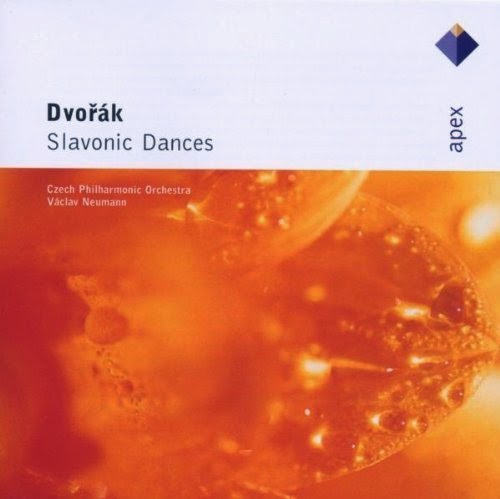
Dvořák - Slavonic Dances Op.46 & 72

"Slovanské tance" (The Slavonic Dances), a series of 16 orchestral pieces composed by Antonín Dvořák in 1878 and 1886 and published in two sets. Originally written for piano four hands, the Slavonic Dances were orchestrated at the request of Dvořák's publisher. The pieces, were well received at the time and today are among the composer's most memorable works, occasionally making appearances in popular culture. Lightly scored and charming sound by Czech Philharmonics and Václav Neumann.

DSD

Dvořák, Janáček, Martinů, Novák, Schulhoff, Eben - Songs My Mother Taught Me

Magdalena Kožená, one of the most acclaimed recitalists of today, presents a personal collection of songs she has known since childhood and that form some of her earliest musical influences. A haunting collection of songs by Czech composers such as Antonín Dvořák, Leoš Janáček, Bohuslav Martinů, Vítězslav Novák, Ervín Schulhoff and Petr Eben, all deeply rooted in the rich Czech folk song tradition.

SMM

Dvořák - Symphony No.7

Symphony No. 7 in D minor''', Op.70,  by Antonín Dvořák was first performed in London on April 22, 1885. He resolved that this symphony will reflect political struggle of Czechs for independence. This album was recorded live by Prague Symphony Orchestra at Smetana Hall of The Municipal House in Prague, October 1992. Conductor: Martin Turnovský.

DS7

Dvořák - Biblical Songs

Biblical Songs (Písně biblické) by Antonín Dvořák, op.99, performed by Vladimír Roubal (organ) and Petr Matuszek (baritone).

DBS


Dvořák - Cello Concerto in B-minor

Exclusive recording of Cello concerto B-minor, op.104 of Antonín Dvořák by famous Russian cellist Mstislav Rostropovich and Czech Philharmonic Orchestra, conducted by legendary Czech conductor Václav Talich. The album was recorded in 1952 and among many versions with the same soloist and different orchestras occupies a unique, irreplaceable position.

DCC

Thursday, April 3, 2014

Dvořák - String Quartet No.13, Waltz No.1

Antonín Dvořák composed his String Quartet No.13 in G major, op.106 in the end of 1895 after his return from America.  Recorded live in Adelaide 2011. Performed by Pavel Haas Quartet, Czech ensemble, already received prestigeous awards, also for performing Dvořák.

DQW