Sunday, April 6, 2014

Zelenka - Magnificat, Psalm 129, Litanie Omnium Sanctorum, Salve Regina

The Magnificat, ZWV 108 of Jan Dismas Zelenka was performed for the first time by Johann Subastian  Bach in Leipzig 1729-1735. It is necessary to quote the liner notes its final "Amen" was copied by J.S. Bach's son Wilhelm Friedeman for use by the Thomaner Choir, at Bach's request. Psalm 129 was written to commemorate Zelenka's father's death. This recording is performed by Prague Chamber Orchestra, Czech Philharmonic Orchestra conducted by Pavel Kühn and Lubomír Mátl with soloists Stanislav Bogunia, Jan Hora, Jana Jonášová, Joachim Vogt, Miroslav Kopp et al.

ZMF


Hirsch - Symphonies Nos.2 & 3

Vladimír Hirsch's Symphony for integrated ensemble and electronics, op. 47, "Defensa" (1997) and "Sinfonia integra per orchestra, organo e percussione", op.52 (1998). Performed by Czech Integrated Ensemble with soloists Martina Sanollová (vocals) and Vladimír Hirsch (organ, other keyboard instruments, electronics). Formally classical compositions, using digitally processed instrumentation and synthetic sounds. Symphony No.3 was performed live in 1999 at the Prague Industrial Festival under the patronage of the Open Society Fund. This album is a revised version of both works from 2003.

H23

Dušek - Piano Concertos

František Xaver Dušek (1731–1799) was a Czech composer and one of the most important harpsichordists and pianists of his time. Dušek composed sonatas, variations and concertos for harpsichord and piano and several symphonies and string quartets. Much of his music is in the galant style of the early Classical period. His piano concertos on this album are perfomed by Karel Kosárek and Prague Chamber Orchestra. It is world premiere recording.
Notice: Not to be confused with Jan Ladislav Dussek (Dusík). 

DFC

Dvořák - Symphonies Nos.7, 8 & 9


Antonín Dvořák - Symphonies Nos.7, 8 & 9 by Czech Philharmonic Orchestra, conducted by Václav Neumann. The output of nine symphonies by Czech composer Antonin Dvořák has ranked continuously, since its completion to this day, amongst the constituent pillars of the European symphonic repertoire as a whole. The sheer strength of Dvořák´s melodic invention has never ceased to enthrall experts and the general public alike. After all, it was found breathtaking even by more than a few of the composer´s prominent contemporaries (as evidenced by Brahms´ statement: "Dvořák´s themes for his subordinate ideas would easily supply me with enough material for principal subjects in my own work..."). The star of Dvořák´s creative genius shines with the brightest magnitude in the sky of world music. His last four symphonies in particular have become firmly embedded as staple parts of the repertoire embraced by professional symphony orchestras worldwide, widely popular with audiences everywhere for their brilliant and thoroughly gratifying instrumentation. This digital recording, made in the 1980s, relies on the century-old authentic interpretive tradition of the Czech Philharmonic Orchestra whose early history saw Antonin Dvořák himself at the conductor´s post, followed by such legends of the baton as Václav Talich, Karel Ančerl, and in his own time, of course, Václav Neumann, a Dvořákian specialist and an artist of inimitable charisma.

DTS

Saturday, April 5, 2014

Martinů - Symphonies Nos.5 & 6, Memorial to Lidice

Symphonies Nos.5 & 6 of Bohuslav Martinů by Czech Philharmonic Orchestra, conducted by Karel Ančerl. Last two symphonic compositions of Bohuslav Martinů - incidentally, works which Ančerl recorded at a time when the exiled composer was less than acceptable to political powers of his home country. The album contains besides Symphony No.5 and Symphony No.6, which is called "Fantaisies symphoniques", also symphonic poem "Memorial to Lidice".

M56

Fišer - Extracta

The horizon of Luboš Fišer’s  (1935-1999) world, as reflected in his compositions, is extensive. It is delineated by broad borders of his cultural knowledge and interests. He understood the excursions into the past only in relation with the present. His works have often both the mood of celebration, and warning as well. Fišer’s contribution to contemporary musical culture is considerable, his compositions often grasp the dynamic lifestyle of our modern era which he managed to express in a lapidary form of almost atomic energy. This album is a selection from his works.

FLE

Janáček - Complete Operas II

The second part of the set with operas From the House of the Dead, The Makropulos Case and Káťa Kabanová as Vol.2 of Complete Operas by Leoš Janáček, completed by Sinfonietta and symphonic poem Taras Bulba. Performed by Wiener Philharmoniker with various soloists, conductor Sir Charles Mackerras.

HOD
TMC
KAT


Janáček - Complete Operas I

Operas Jenufa, Cunning Little Wixen and Excursions of Mr.Brouček as Vol.1 of the set "Complete Operas" of Leoš Janáček, performed by Wiener Philharmoniker and soloists with conductor sir Charles Mackerras.

JEN
CLV
EMB

Michna - Missa Super "The Sun has Come Forth from the Star"

Missa Super "Již slunce z hvězdy vyšlo" (The Sun has Come Forth from the Star) by the ensemble Ritornello, conducted by Michal Pospíšil is a compilative album, artificially creating long version of Adam Michna Christmas Mass by adding various thematically similar compositions to standard liturgical parts of his mass. Michna’s mass, becomes a great and even the greatest musical form precisely when it is placed in the context of everything ”that belongs to it” in the ritual itself and in music.

MMS

Mahler - Symphony No.9

Gustav Mahler (1860, Kaliště, Czechia-1911, Vienna, Austria) was a composer, born in a Jewish, German speaking family in the Highlands in Czechia. He also conducted Czech Philharmonic Orchestra, especially the world premiere of his 7th Symphony. Mahler is regarded as as a great symphonist. To some extent, Mahler is considered also as a Czech composer, both in terms of place of birth, and for his inspiration Czech folk music, which recognizes all the specialized literature in foreign languages ​​except German. This recording is from the set of 10 Mahler symphonies by Rafael Kubelík (1914– 1996),  a renowned Czech conductor. He was chief-conductor of Czech Philharmonic Orchestra and he had first conducted the Czech Philharmonic in 1934 when he was 20 years old. He was director of the Chicago Symphony Orchestra, the Royal Opera House, Covent Garden, general manager of the Metropolitan Opera of the New York City and worked with such orchestras as the Berlin Philharmonic, Boston Symphony Orchestra, Vienna Philharmonic, Orchestre de Paris, Cleveland Orchestra, New York Philharmonic, etc.

MS9


Zelenka - Il serpente di bronzo

Jan Dismas Zelenka´s the Cantata sacra "Il serpente di bronzo", composed in 1730, is sure to become a tidbit for all those in search of rediscovered compositions by the giants of Baroque music. The recording was made by world-acclaimed specialists in Baroque music using authentic period instruments. Performed by Ensemble Inégal, conducted by Adam Viktora with soloists Alex Potter - alto, Petra Noskaiová – alto, Hana Blažíková – soprano, Peter Kooij – bass, Jaroslav Březina - tenor. This recording record is a world premiere.

ZSB

Kaprálová - Portrait of the composer

Vítězslava Kaprálová (1915-1940) was a Czech composer and conductor. Among her teachers were some of the best European composers and conductors of the time Bohuslav Martinů, Václav Talich and Charles Munch. Despite her untimely death from tuberculosis in 1940, Kaprálová created an impressive body of work. There is no doubt that had she lived she would have become one of the most important women composers in Europe.

KPC

Vejvanovský, Zach, Černohorský, Brentner, Rovenský, Linek, Michna - Czech Baroque Music, Vol.2

Collection of Czech Baroque music, vol.2, including compositions of Pavel Josef Vejvanovský (~1640-1693), Jan Josef Ignác Brentner (1689-1742), Bohuslav Matěj Černohorský (1684-1742), Václav Karel Holan Rovenský (~1644-1718), Adam Václav Michna z Otradovic (~1600-1676), Jiří Ignác Linek (1725-1791) and Jan Zach (1699-1773).

CB2

Kabeláč - Symphony No.8, Metamorphoses II

The music of Miloslav Kabeláč is characterised by his own extraordinary artificial tone-creative principles. His musical expression makes use of elements of exclamation, rhythmic shouts, monotonous and exalted invocations, mysterious, magical and symbolic meanings. The basic ideas of Kabeláč’s works is namely an emphatic warning against the danger of a decline of all positive values of humanity in context of the historical situation at the time of the origin of main works (World War II, communist regime in our country and the Soviet occupation of Czechia in 1968). Typical orchestration and and favourite instrumentation: symphonic orchestra, percussion ensemble, organ, piano, mixed choir, solo vocals. Performers Václav Neumann (conductor), Prague Percussion Ensemble, Czech Philharmonic Orchestra, Václav Rabas (organ), František Maxián (piano), Jana Jonášová (soprano).

K8M

Brixi F.X. - Complete Organ Concertos

František Xaver Brixi (1732–1771) was a Czech classical composer and organist of the 18th century. Brixi’s style is distinguished from that of his contemporaries by its fresh melodic writing, vivacious rhythm and lively bass lines. During his lifetime his music was widely disseminated in Czechia. He wrote some 290 church work, cantatas and oratorios, chamber compositions, and orchestral compositions. His organ concertos, which have been recorded several times each, are his best-known pieces today. Performed by Christian Schmitt.

Martinů - Sinfonietta giocosa

Sinfonietta giocosa for piano small orchestra, H. 282 was one of the last works Bohuslav Martinů wrote before managing to leave Europe. He had been a resident of Paris since 1923, leaving his Czech homeland for the joys of the Parisian cultural scene. When Hitler's forces took Czechoslovakia, in late 1938 and early 1939, that ended plans he had developed to return to Prague. This recording permed by Czech Philarmonic Orchestra, conducted by Jiří Bělohlávek

MSG

Janáček - Moravian Folk Poetry In Songs

Czech composer Leoš Janáček devoted a lot of his time and ink on folk songs. This album, "Moravian Folk Poetry In Songs" is a little bit of his work (about 300 songs). Singers Eva Štruplová and Stanislav Předota took the right fair voice to execute those both profound and so light songs accompanied by Adam Skoumal at the piano. While listening to this album, we are travelling through these ageless lights and true emotions of every folk in every day.

JMP

Liška - Music From Short Films by Jan ŠŠvankmajer

Zdeněk Liška (1922–1983) was a Czech composer who produced a large of number film scores across a prolific career. He was very relevatory in development of experimental electronic music, composed for severel movies from the beginning of his work, that started in the 1950s, thrilled in using unique sound sources. He worked notably with animator Jan Švankmajer, scoring several of his films. This alvum is a survey of that cooperation.

LSF

Friday, April 4, 2014

Zelenka - Requiem in D minor, Miserere

Requiem in D minor, ZWV 48, Miserere in C minor, ZWV 57 of Jan Dismas Zelenka performed by Magdalena Kožená (Alto), Helena Pellarová (Soprano), Michal Pospišil (Bass), Ladislav Richter (Tenor), Anna Hlavenková (Soprano), conductor: Roman Válek, Czech Chamber Chorus and Ensemble Baroque in 1994.

ZRM


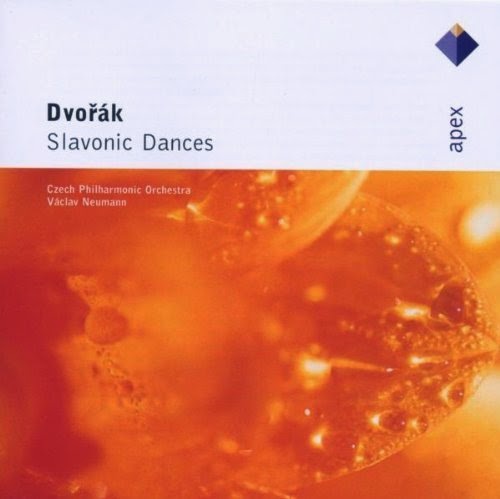
Dvořák - Slavonic Dances Op.46 & 72

"Slovanské tance" (The Slavonic Dances), a series of 16 orchestral pieces composed by Antonín Dvořák in 1878 and 1886 and published in two sets. Originally written for piano four hands, the Slavonic Dances were orchestrated at the request of Dvořák's publisher. The pieces, were well received at the time and today are among the composer's most memorable works, occasionally making appearances in popular culture. Lightly scored and charming sound by Czech Philharmonics and Václav Neumann.

DSD